

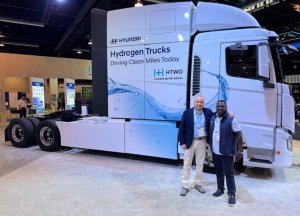
Ali Maher (Rutgers) and Jeffrey Stokes (PSEG) standing in front of a Hyundai XCIENT Fuel Cell Truck on display.
Rutgers will deploy six green hydrogen-powered heavy-duty trucks at Port Newark for drayage operations.
The Rutgers University Center for Advanced Infrastructure and Transportation (CAIT) in the School of Engineering is preparing to deploy and demonstrate hydrogen fuel cell technology as part of an innovative pilot project funded by the New Jersey Economic Development Authority (NJEDA).
Joined by project partners Public Service Enterprise Group (PSEG), the Center for Transportation and the Environment (CTE), Hyundai Motor Company, and the Port Authority of New York and New Jersey, Rutgers CAIT will lead this initiative that has the potential to enhance supply chain efficiency, invest in American infrastructure and jobs, and position New Jersey as a hub for advanced transportation technologies.
“Under Governor Murphy’s leadership, New Jersey continues to make impactful investments into proven clean energy technologies like hydrogen, promoting innovation, creating jobs, and improving quality of life for New Jerseyans,” said NJEDA CEO Tim Sullivan. “With support from the NJEDA, this pilot project will leverage expertise from academia, government, and the private sector to explore the potential of hydrogen-powered trucks, keeping New Jersey on the forefront of innovation and strengthening our long-term economic competitiveness.”
Hyundai’s XCIENT Fuel Cell Trucks will be used for this demonstration. The trucks will operate at Port Newark, a significant component of the Port of New York and New Jersey and the principal container ship facility for goods entering and leaving the Northeastern United States. The facility is run by the Port Authority of New York and New Jersey.
“This pilot is another step in the Port Authority’s broader effort to look at every viable pathway toward a cleaner future for our critical infrastructure and operations,” said Christopher Diamond, Director of the Office of Sustainability at the Port Authority of New York and New Jersey. “Our ambitious commitment to reaching net-zero carbon emissions by 2050 brings with it a responsibility to help chart the course toward greater sustainability across our vast network, including the East Coast’s busiest seaport. We’re eager to take advantage of the region’s innovative spirit to examine emerging technology and accelerate the transition to a more sustainable future.”
Supporting existing drayage operations and supply chain logistics, the trucks will transport shipping containers short distances from the port to warehouses, rail yards, and the next leg of the longer freight journey. Today, this drayage, or short-distance transport of goods, is conducted by fuel-intensive, combustion engine trucks that are typically single-purpose for drayage, serving the same short distance for their useful life.
The project will proceed in phases, beginning with procurement of the trucks and hydrogen supply and the design of the fueling site.
Truck deployment and testing are expected to start in the beginning of 2026.
“It’s about making New Jersey an R&D and workforce training hub for hydrogen-powered transportation,” said Ali Maher, director of Rutgers CAIT and principal investigator. “We’re demonstrating how hydrogen can be integrated into real-world transportation and logistics operations, and we will investigate its potential to drive down costs, improve performance, and support long-term economic growth. This type of applied research is critical to proving the use cases of innovative technology and paving the way for its implementation.”
Rutgers University will manage the project and lead the research, workforce development, and performance validation efforts. CAIT will engage experts from the Rutgers School of Engineering and the Office for Research to identify and document opportunities to build on the successes and lessons learned from this pilot.
PSEG will manage the fueling operations of the six hydrogen-powered trucks.
“PSEG’s expertise in hydrogen across industrial settings well positions us to partner in this initiative at Port Newark,” said Jeffrey Stokes, Senior Director of Renewables Engineering & Technical Support at PSEG. “We’re proud to bring that experience to the forefront as we support truck fueling operations for the project. PSEG aims to drive reliable energy infrastructure while also supporting the state’s efforts to drive economic development.”
CAIT will work with project partner CTE to collect service data on existing drayage operations to establish Key Performance Indicators (KPIs) and benchmarks for the hydrogen trucks.

Aerial view of Port Newark, where the hydrogen trucks will be deployed to support drayage operations. Credit: John McAdorey – stock.adobe.com
“Establishing clear performance benchmarks based on current drayage operations is essential to demonstrating that hydrogen trucks can meet the real-world demands of port logistics,” said Niki Rinaldi El-Abd, senior managing consultant at CTE. “This work lays the groundwork for data-driven decisions that build confidence and drive investment in zero-emission freight solutions.”
After daily truck service begins, the project team will collect, analyze, and report on KPIs for 12 months. At the end of the pilot, the team will develop a comprehensive dataset and snapshot of the benefits and challenges associated with green hydrogen-powered drayage trucks, including shifts in fuel consumption rates, maintenance costs, and port utilization.
The pilot project will also give key insights into obstacles that the transportation industry may have to overcome to effectively implement, maintain, and operate green hydrogen-powered vehicles.
“At Rutgers we see these challenges as opportunities to grow into a 21st-century R&D leader,” said Michael Zwick, senior vice president for research at Rutgers University. “Now is an essential time to invest in transformative technologies and innovative thinking that can position New Jersey and the U.S. ahead of the curve for years to come. We look forward to working together with the NJEDA and our project partners on this important hydrogen initiative.”
